Researchers at Westlake University have determined the structure of the BAX repeating unit shared by various BAX oligomers. The structural information shows how BAX oligomerizes into highly flexible oligomers.
Prof. Yigong Shi’s team published the research article “Structural basis of BAX pore formation” in the journal Science. In this study, the structure of the BAX repeating unit was determined using cryo-electron microscopy.
It was found that the basic repeating unit is composed of four BAX protomers, presenting two conformations (type-I and type-II). Asymmetric dimers assembled by type-I and type-II BAX protomers further dimerize to form the basic repeating unit. Neighboring repeating units can be connected and extended through α9 helices to form higher-order oligomers. The end-to-end stacking of the BAX line yields a BAX ring. In addition, this study also revealed that the tetragonal, pentagonal, hexagonal, and heptagonal oligomers formed by BAX contain 16, 20, 24, and 28 BAX protomers, respectively.
They explained how BAX repeating units assemble into flexible and diverse forms of BAX oligomers (arcs, lines, and rings). Moreover, the question of how activated BAX oligomerizes to promote MOMP, which has puzzled scientists for several decades, has finally been further answered based on the structural information provided by this study.
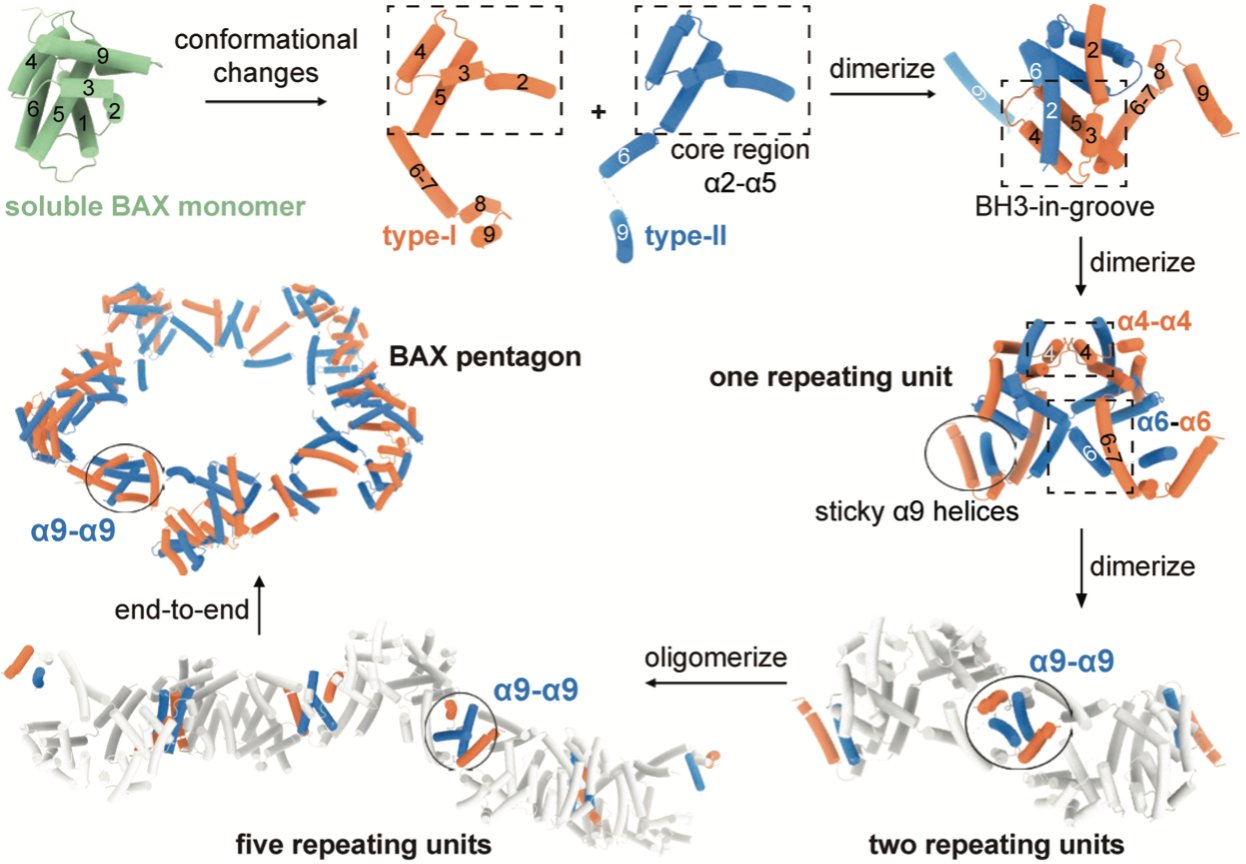
Cryo-EM structure of the activated BAX oligomers.
According to the team, “This research is very difficult. The first problem is how to obtain samples suitable for structural analysis. The second one is how to determine the structures using these highly flexible samples.”
Luckily, experienced and efficient teamwork led to today’s achievement. Ying Zhang and Lu Tian prepared ideal samples, while Gaoxingyu Huang and Xiaofei Ge made great contributions to data processing. “Such success is inseparable from everyone in the team.”